
By: Fatima Khan
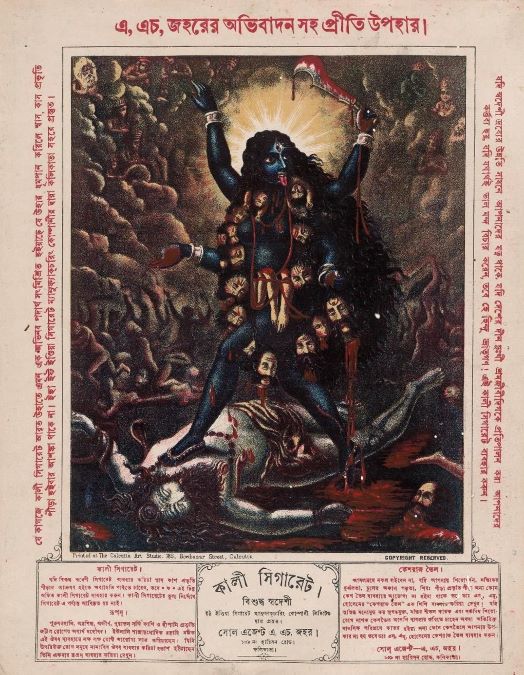
Kali, standing over Shiva, published by the Calcutta Art Studio. Hyperlink for the image of Kali : https://www.britishmuseum.org/sites/default/files/styles/uncropped_medium/public/2022-07/Kali-Calcutta-Art-Studio-994×1280.jpg?itok=0ewanlhl

(Image set as the featured image for this post)
Abstract
The goddess Kali Ma, or Kali, carries a story of transformation and bloodlust, where her identity of destruction and death creates many openings for interpretation across contemplative areas of Hindu literature. She carries a heavy burden on her shoulders as her identity seems to represent a multitude of archetypes, a nurturant devourer of her enemies with complex contrasting values. By analyzing Kali’s role in her story and connecting her struggle to a people’s, this blog post discusses how Kali’s deification and vilification can become a weapon for and against the one perceiving it.
Kali’s Complex Deification and Vilification for a People
Kali, consort of Lord Shiva, holds significance among the women of India as her character is independent and wrathful to those who wrong her. As the roots of feminism took hold in Indian society, Kali’s traits opposed the suffocating female ideals of the time.1 Kali’s rebellious and violent nature had become a beacon of empowerment for feminism in India, where calm and motherly Sita was often employed to cage Indian women and their desires. Sita’s devotion to her husband and submissive character were used to withhold the average Indian woman from choosing her own path and deviating from the norm. However, Kali’s rageful nature when killing her enemies and tendency to challenge Lord Shiva were seen as a proper rejection of a patriarchal society. She is deified by the female Indian population, where her existence contrasts the expected ideals for women. Kali is liberated in her thoughts and free spirited, which is discouraged from the female Indian population.2
Conversely, Kali’s tendency to act independently and violently is vilified by those who support the patriarchy and benefit from it. Whether it be a majority of the Indian male population or women who have been convinced to remain submissive to a patriarchal system, Kali’s character is fearsome to those who choose to honor society’s binding rules. I want to mention that women who do choose a domestic and life for themselves are not shameful, however it should be her choice. Kali returns the right to choose for herself, to instinctively destroy and create according to her free will. To a society where the women are kept hidden and quiet, this is threatening and must be rejected.
Kali’s Deification Against the Colonizing British
During colonial British rule in the region of South Asia, Kali’s perceived identity seemed to shift with the public as her destructive and violent nature was used as a weapon against the British. Playing on British paranoia, her identity was depicted in a more violent and bloody thirsty manner. In one instance, Kali is ‘called upon’ by her followers who engage in a corpse ritual, ultimately for the end of unjust colonial order.3 Additionally, a cigarette company by the name ‘Kali Cigarettes’ advertised an image of Kali wearing a belt of severed European heads and limbs, with her hands raised in a victorious manner.4 In this case, Kali’s identity is deified to incite emotions of unease and fear in those who were attempting to colonize the region. Her independence is what makes her the perfect embodiment for a call to revolution.
Kali’s transformation into a symbol of resistance showcases the adaptability and complexity of her character. As oppression intensified, her image provided a means for the oppressed to channel their anger and frustration. Whether it be the women of India or the colonized, her iconography was used to blend religion with defiance. This use of Kali highlights how deities can be reinterpreted to serve contemporary needs, reflecting dynamics of power and resistance. Ultimately, Kali’s symbolism against British rule and the patriarchy illustrated the cultural and religious identity of the colonized and their struggle for autonomy.
A Contradiction Where I Chime in
Kali is often described as a cycling mix of creation, destruction, nature, and time. Her embodiment of shakti (female power) blended with her sensual and courageous nature gives her dimension and value. Despite this complexity, Kali’s identity is taken at face value and categorized to serve a specific cause. She is deified as a liberator and vilified as a threat, depending on what she is made to represent. This dichotomy reflects how her character is manipulated to be a weapon of the perceiver, that in my opinion can lead to contradictory representations.
On one hand, Kali is celebrated as a symbol of resistance and empowerment, particularly in feminist contexts where her independence and defiance offer relief to the ideals imposed on women. She becomes a rallying point for those attempting to break free from patriarchal norms, with her imagery being a source of rebellion. On the other hand, the same traits that inspire empowerment are also used to paint her as a controller of chaos and violence, particularly by the individuals enforcing patriarchal ideas.
This illustrates how Kali’s image is tweaked to fit many narratives, whether to inspire fear in colonial forces or to advocate for women’s liberation. Each interpretation utilizes different aspects of her nature, but none fully captures her true essence. Kali, therefore, becomes a paradoxical figure, whose identity changes to reflect resistance and societal expectations. Her powerful representation shows the inherent tension in using deities as symbols for diverse causes, revealing more about the interpreters than about Kali herself.
References
Chatterjee, A. (2020, November 11). Why Goddess Kali is the quintessential feminist icon we need today. Tweak India. https://tweakindia.com/culture/discover/why-goddess-kali-is-the-feminist-icon-we-need-today
Singh, S. (2023). The Nurturant-Warrior Archetype: a Meeting Ground Between the Metaphors of Sita and Kali in Vedic Hinduism. Human Arenas: An Interdisciplinary Journal of Psychology, Culture, and Meaning, 6(4), 911–925. https://doi.org/10.1007/s42087-021-00258-3
Wolfers, A. (2020, December 9). Kali rises in the East. The British Museum. https://www.britishmuseum.org/blog/kali-rises-east