
City of Intersections
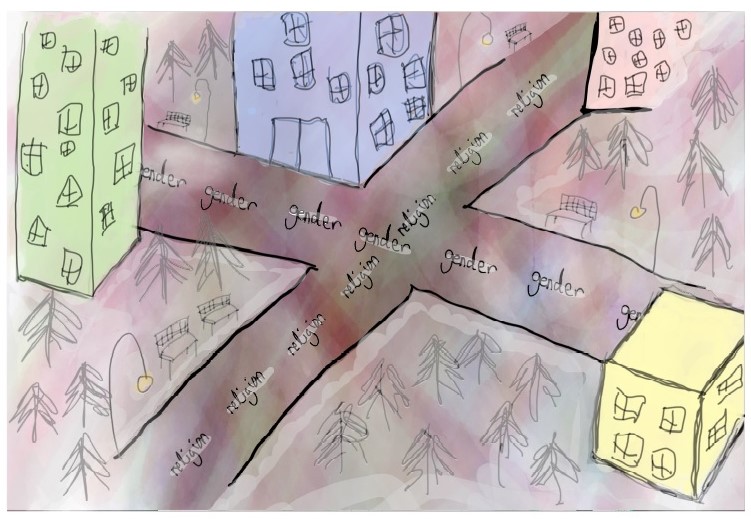
Note: Digital art created June 26, 2024. Text on roads: “gender” & “religion”. Author’s work.
By: Alex Lepa (they/he)
Politics, gender, money, race, and religion are conversation topics to be avoided at polite, stereotypical patriarchal dinner tables. Although this blog post won’t delve into all those topics, I intend to demystify stereotypes that perceive religion as rigid and gender as binary. Through analysis of the gender non-conforming Hindu mythological being of Ardhanarishwara, I’ll challenge societal misconceptions that gender must be binary, especially in relation to religion. Biswas (2012) skillfully asserts that “the gender binary itself is an illusion” (p. 11) when discussing Hindu interpretations of gender, specifically referencing Ardhanarishwara. Gathering ideas from authors such as Biswas (2021) and Kaul (2010), I explain the development and societal understanding of Ardhanarishwara before exploring my individual connection with them, both academically and personally. I argue that through mythological, visual, and literary representations of Ardhanarishwara, gender non-conforming Hindus can see visual representations of a variety of gender expressions, allowing them to relinquish societal tropes that confine people and religions into rigid categories.
Ardhanarishwara was challenging to research within academia, as this figure hasn’t been focused much in Hinduism, gender, and divinity. Borrowing from Crenshaw (1991), I speculate Ardhanarishwara’s exclusion is due to the spaces they’ve occupied. I was guided by Crenshaw (1991), my own feminist experiences, and other scholars such as Johnson (2021) whose seeks to discern how God is conceptualized psychologically. These mechanisms of exclusion, inclusive language, and representation of characters within mythology synthesized during my research, although I found most sources in the fine arts. Circling back to Ardhanarishwara, the only academic sources that named them directly include Biswas’s poetry (2021), as well as a critique on Indian Theatre (Kaul, 2010). I also draw from a variety of popular culture sources such as online magazine and reviews.
Two main components of Ardhanarishwara directly relate to their positionality within Hindu mythology. One piece concerns how society perceives this figure’s gender and divinity, since they’re composed of half Parvati and half Shiva. Thus, they exist as both aspects of themself by being “natural cohabitants within the self” (Kaul, 2010, p. 1). This brings together Hindu fundamental principles that support the conceptualization of Ardhanarishwara’s spiritual side, understanding that “being at once male and female does not deny the divinity” (Rao, 2019, Saguṇa Brahman as a Path to Liberation, para. 2). To claim Ardhanarishwara is a Hindu God is far-reaching; this is because they do seem to have retained and held their divinity, but they also have a varied reputation across different academic contexts as well as regional expressions. To some they’re a “Queer God” (Rao, 2019) who represents divinity, and to others they’re not included in the list of goddesses and gods who are categorized according to binary gender (Tewari & Tewari, 2009). As a result of the confusion, I was drawn towards Johnson’s (2021) article that contextualizes God as part of individuals’ belief systems that interact with larger framework of societal religions. Borrowing from Johnson’s (2021) work, I believe in Ardhanarishwara’s power and agree that they’re a God and/or Goddess figure, with the nuance that they also hold specific human-like qualities.
As a student of religious studies and gender studies, I’m interested in the intersections of individual and collective identities both historically and currently. From an academic and feminist perspective, the positionality of Ardhanarishwara simultaneously challenges and aligns with how Crenshaw (1991) describes the “cultural construction of women of color” (p. 1245). Being within two or more separate identity categories brings complexity to the already complicated workings of power – its impact on and circulation through various groups. Ardhanarishwara represents a way of authentic being in which a fluid and dynamic comprehension of self is celebrated. The possibility of self-definition crosses gender and religious boundaries that historically have confined individuals into certain ways of being that are regulated and controlled by those in power. On a more personal note, it’s very encouraging to learn more about gender and religion connecting in these interesting ways as it returns a sense of child-like wonder that I often seek outside of academia. Borrowing from Lorde’s (2003) idea about using the master’s tools to redefine one’s identity, Ardhanarishwara represents the breaking down of the house’s walls to reveal the diverse landscape that I hold to be true to who I believe I am. Both visual and literary mythological representations of gender nonconformity allow me to connect with figures who, just like me, have also been on the margins of society and existence. The power of connection through storytelling and varied narrative accounts creates spaces where the lines and boundaries of society are allowed to be blurred.
I see potential in my perspective to hold a bias which favors gender-queer queer or non-conforming creatures and characters and places them in a positive light. This idealizing of religious figures as a response to my belief systems, although being one of the pieces mentioned in Johnson’s (2021) report, is also an interesting area of further study for religious studies scholars who work within social justice fields. Another interesting realm of potential research includes further research of Ardhanarishwara from various perspectives, as I mentioned earlier that they’re an unresearched, yet significant, figure in both Hinduism and queer and trans studies.
This essay deconstructed traditional stereotypes which paint religion as reflecting the gender binary themes, by elaborating on the influences and development of Ardhanarishwara. This mythological character and their representations in literature provides both me and other spiritual and gender diverse people an opportunity to see themselves reflected in the texts they consume. By both acknowledging and disengaging from Crenshaw’s (1991) intersectionality theory, I found myself in a distant land and came across a friend. Their name was Ardhanarishwara, and I enjoyed their company and learning about them, which is allowing me to grow and see the diversity that’s inherent in the world. This ignited my curiosity which helped me to refocus my understanding of identity both personally and academically. Characters and mythologies such as Ardhanarishwara are critical to highlight in the contemporary world, especially as there’s a risk for their presence to get buried under all the new content being created by societies. I just hope that we don’t lose sight that like many other systems and structures, such as religion, “the gender binary itself is an illusion” (Biswas, 2021, p. 11).
References
Biswas, P. M. (2021, December 15). The Divine as Non-Binary: The Ambiguous Transpoetics of Three Trans, Genderfluid and Genderqueer Figures from Hindu Mythology. On_Culture: The Open Journal for the Study of Culture (Online), 1(12). https://doi.org/10.22029/oc.2021.1256
Crenshaw, K. (1991, July). Mapping the Margins: Intersectionality, Identity Politics, and Violence against Women of Color. Stanford Law Review, 43(6), 1241–1299. https://doi.org/10.2307/1229039
Johnson, K. A. (2021). God. . . Karma, Jinn, spirits, and other metaphysical forces. Current Opinion in Psychology, 40, 10–14. https://doi.org/10.1016/j.copsyc.2020.08.001
Kaul, R. (2010). Redefining Femininity in Modern Indian Theatre. Critical Stages (Paris), 3.
Lorde, A. (2003). The master’s tools will never dismantle the master’s house. In Lewis R., & Mills, S. (Eds.). Feminist Postcolonial Theory a Reader (1st ed., pp. 25–28). https://doi.org/10.4324/9780203825235
Rao, S. (2019, April 1). The Hindu Theology of Ardhanarīśvara, the Queer God. Medium. https://shashankrao-84497.medium.com/the-theology-of-ardhanar%C4%AB%C5%9Bvara-the-queer-god-dd2a6aa3eda5
Tewari, B., & Tewari, S. (2009, June 15). The history of indian women: Hinduism at crossroads with gender. Politikologija Religije, 3(1), 25–47. https://doi.org/10.54561/prj0301025t