
By: Wazma Rahmani
A widely practised form of worship in India is that of the Great Mother or the supreme divine power in various forms, with one of the most popular being Kali’s (Chaudhuri, 1956, p. 123). Kali is a Hindu goddess linked to death, time, and doomsday and is often connected with themes of sexuality and violence. However, she is also revered as an influential maternal figure and a symbol of motherly affection. Representing Shakti – the feminine force – Kali is an incarnation of Parvati, the consort of the great Hindu god Shiva (Cartwright, 2022; Doniger, 2024). Although it is not precisely known how ancient the Kali cult is, some scholars argue that it may be among “the oldest religioso-esoteric institutions of India” (Chaudhuri, 1956, p. 125). Despite all this, Kali is often associated with death and destruction and even though her loving side may appeal to some, it is her terrifying side that is frequently emphasized at the cost of the former (Marsman, 2019, p. 184; Kinsley, 1997, pp. 285 & 286; McDermott, 1997, p. 299).
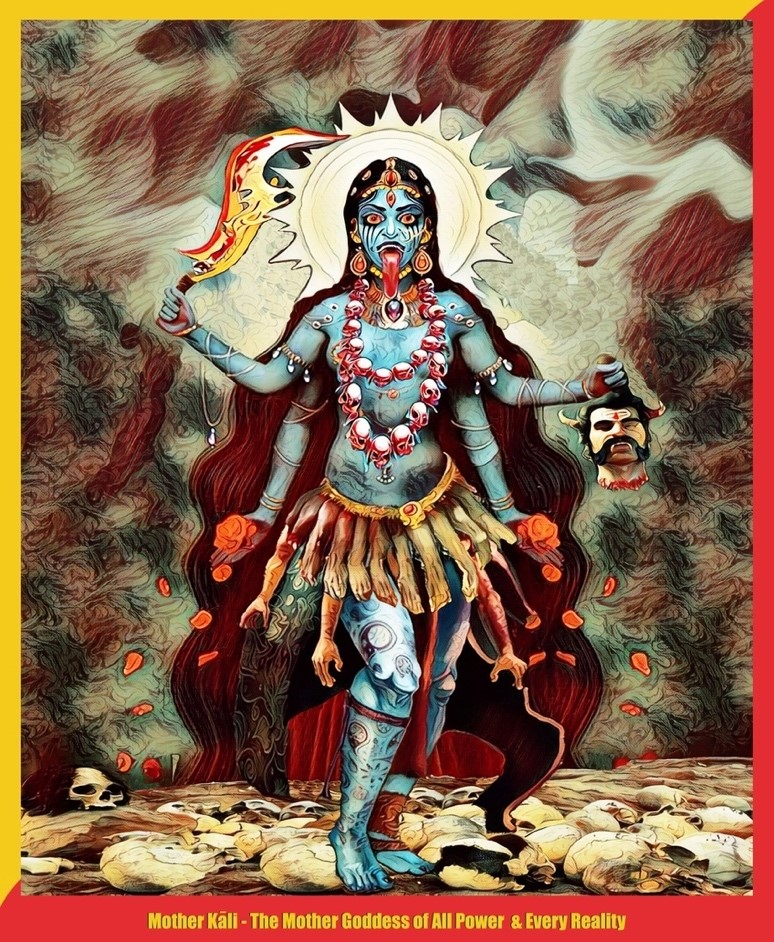
Image courtesy: https://kalimaa.home.blog/
Kali is often depicted as a fearsome and terrifying figure. She is portrayed as dark blue or black, with wild, dishevelled hair flowing behind her. Her face is frightful, with a red hanging tongue, sharp fangs, and lips often covered in blood, yet she appears smiling. Kali’s body is adorned with gruesome ornaments: a necklace of human skulls or freshly cut heads, a girdle made of severed arms, and infant corpses as earrings. She is usually naked, with long, sagging breasts, and her figure is threatening. She wields a bloodied cleaver in one hand, a freshly cut human head in another, and gestures of “fear not” and boon-giving with her other hand. Kali is often found on battlefields or cremation grounds, where snakes, jackals, and ghosts surround her, sitting on corpses or riding a ghost. Known for her appetite for blood, she drinks the blood of her enemies and is associated with the murderous Thugs. Despite her fearsome appearance and habits, her temples, once found on civilization’s fringes, are now located in cities and towns (Chaudhuri, 1956, p. 126; Kinsley, 1997, pp. 77-78; Marsman, 2019, pp. 184-185; Doniger, 2024).
The origins of Kali are quite ancient, and although no one knows definitely how ancient the Kali cult is, approximately 2,500 years ago, Kali’s name first appears in Hindu scriptures in the Mundakopanisad, identified as one of Agni’s seven flaming tongues, the Vedic fire god. (Marsman, 2019, 185; McDermott, 1997, p. 297). Her emergence as a goddess is also noted in the Kathaka Grhyasutra, a late Vedic text, where she is among the deities invoked with perfume offerings during marriage ceremonies. By the fifth century BCE, Kali is depicted furiously and destructively in the Mahabharata, where the assault on the Pandava brothers’ camp is attributed to Kali (Marsman, 2019, p. 185).
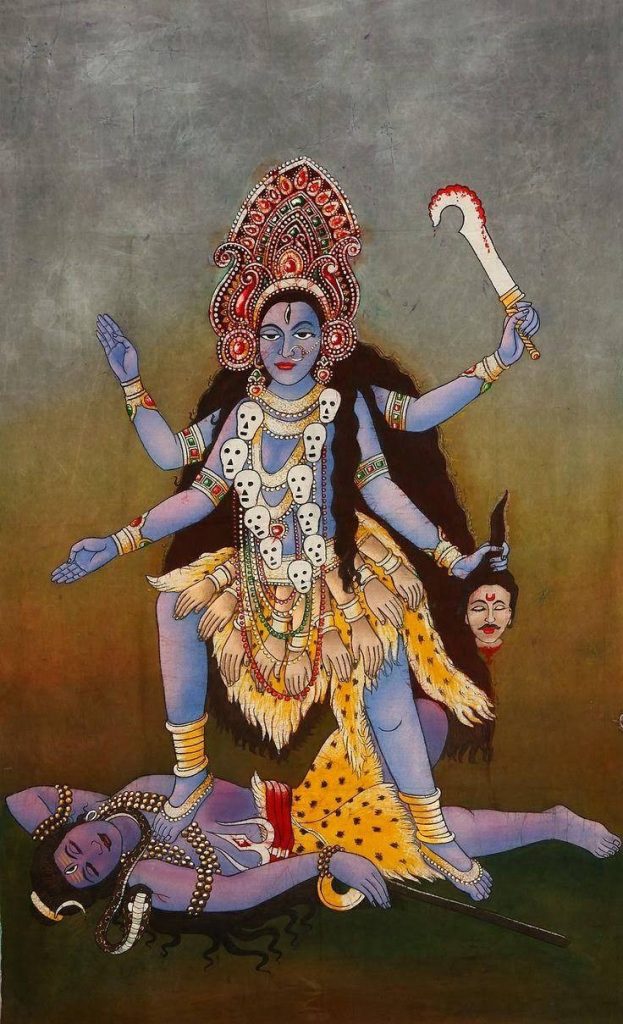
Image Courtesy: https://wallpapers.com/wallpapers/maa-kali-on-top-of-shive-on-brown-wall-kb84mxnxf82sdwf5.html
Although numerous stories are associated with the rise of Kali, according to Marsman (2019), in the fifth or sixth century CE, a “unique text” emerged that played a crucial role in shaping a pivotal moment in Indian religious history. Known as the Devi Mahatmyam, In Praise of the Goddess, the text spans around 4,000 years, and its stories form the foundation and current practice of goddess worship in India today (Marsman, 2019, pp. 185-186). In the Devi Mahatmyam, Kali appears three times as the great goddess who is the universe’s origin and grants ultimate knowledge and liberation, gaining prominence and equating with other goddesses (Marsman, 2019, p. 186; McDermott, 1997, p. 297). As described in the text, Kali is born when two demon generals, Canda and Munda, are sent to provoke and attack Durga. In her fury, Durga loses her composure, and from her forehead, Kali emerges. Howling ferociously, Kali charges into the demon army, crushing and devouring her enemies, ultimately decapitating Canda and Munda. Later into the battle, Durga summons Kali to kill the demon Raktabija, whose supernatural ability allows him to recreate himself whenever a drop of blood touches the ground. Durga’s attempts to wound Raktabija only worsen the situation, as the battlefield soon plagues with Raktabijas. Kali saves Durga by swallowing the blood-born demons and draining the blood from the original Raktabija until he falls lifeless (Kinsley, 1997, p. 78; Rajendran, n.d.).
Image Courtesy: https://kalimaa.home.blog/
Regardless of the origins of the Kali cult, it is safe to say that Kali has no equivalent among other known goddesses; whether it be her appearance or her actions, Kali differs widely. And even though she has been said to encompass three distinct elements within herself: the fertility and nourishing aspects of a mother, the destructive force in nature, and life itself, it is her nature as a union of opposites, embodying both creation and destruction, birth and death, love and fear, her dual character as the “Terrible Mother” that garners the most attention (McDermott, 1997, p. 285; Chaudhuri, 1956, p. 126). Kali represents the mother image toward which the infant feels ambivalent, experiencing both love and fear. She embodies both the roles of protector and destroyer; thus, she is both the good and bad mother (Chaudhuri, 1956, pp. 134-135). And even though for some Kali may seem like a goddess who disrupts stability and order, even if she does serve order by slaying demons, she often becomes so chaotic on the battlefield, typically getting drunk on the blood of her victims, that she starts to destroy the very world she is meant to protect, for many, Kali is a symbol which brings healing in a society dominated by men. Thus, no matter how much patriarchy tries to suppress and demonize Kali’s powerful, sexual and dark natures, many find those same natures liberating. Kali influences some people’s lives by enabling them to accept the aspects of themselves that were once repressed and feared, thus becoming “a goddess of transformation” (McDermott, 1997, pp. 290-291; Kinsley, 1997, pp. 80 & 82).
Bibliography
Cartwright, M. (2022, September 27). Kali. World History Encyclopedia. https://www.worldhistory.org/Kali/
Chaudhuri, A. K. R. (1956). A Psycho-analytic Study Of The Hindu Mother Goddess (Kali) Concept. American Imago, 13(2), 123–146.
Doniger, W. (2024). Kali. Encyclopædia Britannica. https://www.britannica.com/topic/Kali
Download divine image of goddess Maa Kali overseeing lord shiva wallpaper. Wallpapers.com. (2023, September 1). https://wallpapers.com/wallpapers/maa-kali-on-top-of-shive-on-brown-wall-kb84mxnxf82sdwf5.html
Kinsley, D. R. (1997). Kali: Blood and Death Out of Place. In Devi: Goddesses of India (pp. 77–86). essay, University of California Press.
Kāli Maa Conceptual Devotional Exploration. (n.d.). https://kalimaa.home.blog/
Marsman, M. A. (2019). Kali: In praise of the goddess. Psychological Perspectives, 62(2–3), 184–192. https://doi.org/10.1080/00332925.2019.1624445
McDermott, R. F. (1997). Epilogue: The Western Kali. In Devi: Goddesses of India (pp. 281–314). essay, University of California Press.
Rajendran, A. (n.d.). Goddess Kali story – various stories of Kali Mata and symbolism. Goddess Kali Story – Various Stories Of Kali Mata And Symbolism. https://www.hindu-blog.com/2019/10/goddess-kali-story-various-stories-of.html