By: Emily Alexandria
The United Nations report on the prevalence of substance use in 2021 claimed that 1⁄3 of the world’s opioid usage is found in South Asia.1 In a second set of statistics, North America boasted the highest rate of cocaine usage, tripling that of the entire continent of Asia,2 which contains approximately 60% of the world’s population.3 With addiction rates at an all time high in North American cities and growing throughout South Asia, the Wat Thamkrabok monastery in Thailand seems to offer a miracle cure; “a drug addiction rehabilitation program which claims a 70% success rate.”4 This paper will discuss the addictions treatment at Wat Thamkrabok Monastery and apply this case study to the Buddhist philosophy of paticca samuppada, concluding with a Western approach to substance use and recovery.
Recovery is a once in a lifetime opportunity, a statement taken literally at Wat Thamkrabok. Participants are only able to attend this treatment centre once. There are no re-admissions. Monk Gordon, a spiritual teacher at the monastery explains that the temple’s name, “Thamkrabok, means temple of the pipe cave, which refers to the opium pipe.”5 Taking a sacred vow called a sajja, a person commits to abstinence from substance use for life, acknowledging that “if he breaks this vow, the spirits will punish him.”6 When evening falls on the first day, this vow is taken publicly in the presence of a monk in front of a statue of Buddha. While adherence to the Buddhist faith is not a requirement of treatment, “spiritual treatment is the primary approach to rehabilitation”7 and participants make their vows in accordance with their own beliefs. Upon reciting the vow, the process of detoxification begins on the same night.
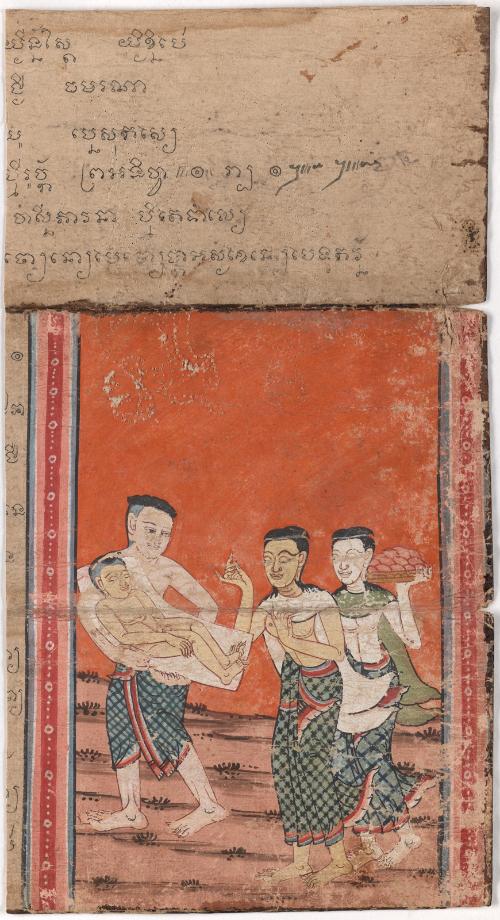
Former Abbot of Wat Thamkrabok, Phra Chamrun Panchan, discovered a herbal medicine which “if administered in a therapeutic community based in his monastery, is highly successful in curing heroin and opium addicts.”8 This herbal treatment is an emetic, emptying the stomach and attempting to “cleanse the body of drugs, which must be removed from deep down in the bones.”9 This treatment is a “decoction from a selection of 100 fresh and dried emetic and purgative herbs and bark,”10 which is administered to participants for the program’s first five days. These herbal concoctions include crinum amabile dorn, a flowering plant whose bulb is used as an emetic while the leafs can be used for joint pains.11 The first five days of the program consist of this herbal-induced vomiting, “done a total of nine times, once on the evening of the first day, and then twice daily, morning and evening, during the next four days.” 12 Afterwards, participants enter into a phase of recovery, resting from the physical exhaustion of retching and the mental and bodily pains of detoxification. On the sixth day and onwards, monks share Buddhist teachings, and participants are free to wander the compound, sharing and reflecting on their experiences with others. After only ten days, a person is free to leave. Longer stays are optional at the desire of the participant.
Wat Thamkrabok holds a miraculous claim that “over 70% are cured of addiction to heroin and other drugs,”13 with over 150,000 people who have partaken in treatment. How are these high results achieved? One answer can be found in the principle of co-dependence. The treatment takes place in a communal setting, emphasising fellowship with other addicts and a connection to nature through herbal medicines and the surrounding forest. The resources a person uses, interactions one has with others, and the outcomes of one’s decisions all contribute to a person’s present state. This is the principle of paticca samuppada, a “co-dependent arising, which embraces all life and non-life in a web of interdependence.”14 Using Indra’s net as an analogy for interconnectedness, paticca samuppada can conceptualise human existence as a jewel in the cosmic web of Indra. In the heavenly abodes of this Hindu deity, a wondrous net had been hung in the cosmos with a single jewel fastened in the centre, spreading to infinite lengths. The jewels multiplied as the net trailed to the far expanses of the universe. If one zoomed in on any particular jewel on the net, they would discover “that in its polished surface there are reflected all the other jewels in the net, infinite in number. Not only that, but each of the jewels reflected in this one jewel [are] also reflecting all the other jewels, so that there is an infinite reflecting process occurring.”15 This cosmic illustration is an analogy of what occurs in human life. If one were to select a person and zoom in on their life, one would find other people reflected in that person. We are a product of the people, decisions and environment around us, as “the universe is interwoven and the human self is just one jewel among infinite others.”16 In the Temple of the Pipe Cave, this co-dependent nature is found in the camaraderie between people going through detoxification and healing at the same time.
In the Western world, the city of Edmonton, Alberta, offers several community based programs aimed at those struggling with substance use, including a housing access program, a health clinic, and a safe consumption site. Whereas in Thailand, “the use of recreational drugs is illegal, and repression is the dominant societal response,”17 safe drug consumption sites were introduced in Canada as a means of reducing the stigma around drug use and providing people with a dignified place for substance use. For those seeking treatment, the process is similar to that of Wat Thamkrabok where those “who have not come of their own free will are not admitted,”18 as a person must make this choice for themselves. While the temple operates on goodwill and has “no cost to attend the program…rely[ing] on donations for support,”19 rehabilitation facilities in Edmonton, Alberta area utilized over 12.5 million Canadian dollars per year in 2023.20 Among 14 different treatment facilities in the Edmonton area, there were only 259 beds available for overnight stays in total. In a report on public disorder and crime since the opening of a safe consumption site in the Edmonton core, Edmonton Police Services have “seen a significant increase in the number of calls for service since the Boyle McCauley safety consumption site opened…[and] a larger increase in the number of occurrences (crime) since the opening”21 of these consumption sites.
As a global epidemic, “addiction can be understood as an excessive attachment to and craving for drugs which provide sensual pleasure,”23 causing a bond that is painful to break. The success of the program at Wat Thamkrabok provides a holistic approach to addiction recovery that goes beyond physical cravings and acknowledges that once a person goes through the process of detoxification, the “battle then becomes a mental and spiritual one.”24 The Buddhist teachings, co-dependent nature of the program, and taking a sacred vow are all elements of the program at Wat Thamkrabok which mentally reinforces a person’s commitment to pursue sobriety. While there are limitations to the data collected at the temple, the program grows steadily as it “continues to take in over 400 new addicts”25 monthly, and provides a valuable alternative to Western practices of rehabilitation that may benefit from the introduction of this holistic method of recovery.
Endnotes:
1 World Drug Report 2023 – Statistical Annex,” United Nations : Office on Drugs and Crime, 2021, https://www.unodc.org/unodc/en/data-and-analysis/wdr2023_annex.html, Table 1.1.
2 Ibid, 439.
3 “Asia: Total Population,” United Nations Department of Social and Economic Affairs, 2022, https://population.un.org/wpp/Graphs/Probabilistic/POP/TOT/935.
4 Mark E. Barrett, “Prevention Programs:Wat Thamkrabok: A Buddhist Drug Rehabilitation Program in Thailand,” Substance Use & Misuse 32, no. 4 (January 1997): 435–59, https://doi.org/10.3109/10826089709039364, 435
5 Mark E. Barrett, “Prevention Programs:Wat Thamkrabok: A Buddhist Drug Rehabilitation Program in Thailand,” Substance Use & Misuse 32, no. 4 (January 1997): 435–59, https://doi.org/10.3109/10826089709039364, 448.
6 Ibid, 439.
7 Ibid.
8 David L. Gosling, Religion and Ecology in India and Southeast Asia (Abingdon, Oxon: Taylor and Francis, 2013), 97.
9 Mark E. Barrett, “Prevention Programs:Wat Thamkrabok: A Buddhist Drug Rehabilitation Program in Thailand,” Substance Use & Misuse 32, no. 4 (January 1997): 435–59, https://doi.org/10.3109/10826089709039364, 443.
10 The First Abbot of Thamkrabok Monastery,” Official Wat Thamkrabok Homepage, 2015, https://wat-thamkrabok.org/the-first-abbot/.
11 David L. Gosling, Religion and Ecology in India and Southeast Asia (Abingdon, Oxon: Taylor and Francis, 2013), 179.
12 Mark E. Barrett, “Prevention Programs:Wat Thamkrabok: A Buddhist Drug Rehabilitation Program in Thailand,” Substance Use & Misuse 32, no. 4 (January 1997): 435–59, https://doi.org/10.3109/10826089709039364, 440.
13 Mark E. Barrett, “Prevention Programs:Wat Thamkrabok: A Buddhist Drug Rehabilitation Program in Thailand,” Substance Use & Misuse 32, no. 4 (January 1997): 435–59, https://doi.org/10.3109/10826089709039364, 435.
14 David L. Gosling, Religion and Ecology in India and Southeast Asia (Abingdon, Oxon: Taylor and Francis, 2013), 93.
15 Thayer-Bacon, Barbara J. “Sky: Indra’s Net.” Counterpoints 505 (2017): 92.
16 Culliney, John L., and David Jones. The Fractal Self : Science, Philosophy, and the Evolution of Human Cooperation. Honolulu, [Hawaii: University of Hawaii Press, 2017, 152.
17 Myrtille Proute and Sophie Le Coeur, “Risky Injection Practices and HCV Awareness in Chiang Mai Province, Thailand: A Respondent-Driven Sampling Study of People Who Inject Drugs – BMC Public Health,” BioMed Central, September 24, 2020, https://bmcpublichealth.biomedcentral.com/articles/10.1186/s12889-020-09549-w.
18 Mark E. Barrett, “Prevention Programs:Wat Thamkrabok: A Buddhist Drug Rehabilitation Program in Thailand,” Substance Use & Misuse 32, no. 4 (January 1997): 435–59, https://doi.org/10.3109/10826089709039364, 439.
19 Ibid, 438.
20 AHS Addiction & Mental Health Data Summaries, February 2024, https://pub-edmonton.escribemeetings.com/filestream.ashx?DocumentId=212905, 6.
21 Hannah L Brooks, rep., ed. Elaine Hyshka, Community Impact of the Boyle McCauley Health Centre Supervised Consumption Service (CRISM Prairies, January 31, 2019),
statistical data is unavailable on the success of addictions recovery programs in the city, these safe consumption sites have made an estimated 1,239 service referrals to addictions and mental health programs 22 in 2023.
https://crismprairies.ca/wp-content/uploads/2019/03/BMHC_90Day_Report_Jan31_19_finalc opy.pdf, 27.
22 Ibid, 27.
23 Mark E. Barrett, “Prevention Programs:Wat Thamkrabok: A Buddhist Drug Rehabilitation Program in Thailand,” Substance Use & Misuse 32, no. 4 (January 1997): 435–59, https://doi.org/10.3109/10826089709039364, 454.
24 Ibid, 455.
25 Ibid, 457.
Bibliography
AHS Addiction & Mental Health Data Summaries, February 2024. https://pub-edmonton.escribemeetings.com/filestream.ashx?DocumentId=212905.
“Asia: Total Population.” United Nations Department of Social and Economic Affairs, 2022. https://population.un.org/wpp/Graphs/Probabilistic/POP/TOT/935.
Barrett, Mark E. “Prevention Programs:Wat Thamkrabok: A Buddhist Drug Rehabilitation Program in Thailand.” Substance Use & Misuse 32, no. 4 (January 1997): 435–59. https://doi.org/10.3109/10826089709039364.
Brooks, Hannah L. Rep. Edited by Elaine Hyshka. Community Impact of the Boyle McCauley Health Centre Supervised Consumption Service . CRISM Prairies, January 31, 2019. https://crismprairies.ca/wp-content/uploads/2019/03/BMHC_90Day_Report_Jan31_19 _finalcopy.pdf.
“The First Abbot of Thamkrabok Monastery.” Official Wat Thamkrabok Homepage, 2015. https://wat-thamkrabok.org/the-first-abbot/.
Gosling, David L. Religion and ecology in India and Southeast Asia. Abingdon, Oxon: Taylor and Francis, 2013.
Proute, Myrtille, and Sophie Le Coeur. “Risky Injection Practices and HCV Awareness in Chiang Mai Province, Thailand: A Respondent-Driven Sampling Study of People Who Inject Drugs – BMC Public Health.” BioMed Central, September 24, 2020. https://bmcpublichealth.biomedcentral.com/articles/10.1186/s12889-020-09549-w.
“World Drug Report 2023 – Statistical Annex.” United Nations : Office on Drugs and Crime, 2021.