TPACK (Technological, Pedagogical And Content Knowledge) is a model which “attempts to identify the nature of knowledge required by teachers for technology integration in their teaching, while addressing the complex, multifaceted and situated nature of teacher knowledge.” (Mishra & Koehler, 2006) It extends Lee Shulman’s model of Pedagogical Content knowledge (Shulman, 1986), acknowledging that in addition to what teachers know about what they’re teaching and what the know about how to teach, they also know about the tools they use when teaching.
I’ve been trying to write about TPACK for a while now but I keep not finishing because I get bogged down in absolutely gigantic examples and so I’m going to try to break my writing about TPACK down into smaller bits. I want to talk about why I *like* TPACK first. Then I’ll tackle some of the other things I think are good to keep in mind.
I’ve written a primer on TPACK (and its buddy SAMR) with my colleague Lorelei Anselmo, as a resource for the Taylor Institute. We wanted a unified resource to refer to TPACK and SAMR, since they tend to have some ad-hoc references out on the web, and at least half the time these don’t go back to the original writings by the original authors. If you’re looking for more TPACK references check out TPACK.org.
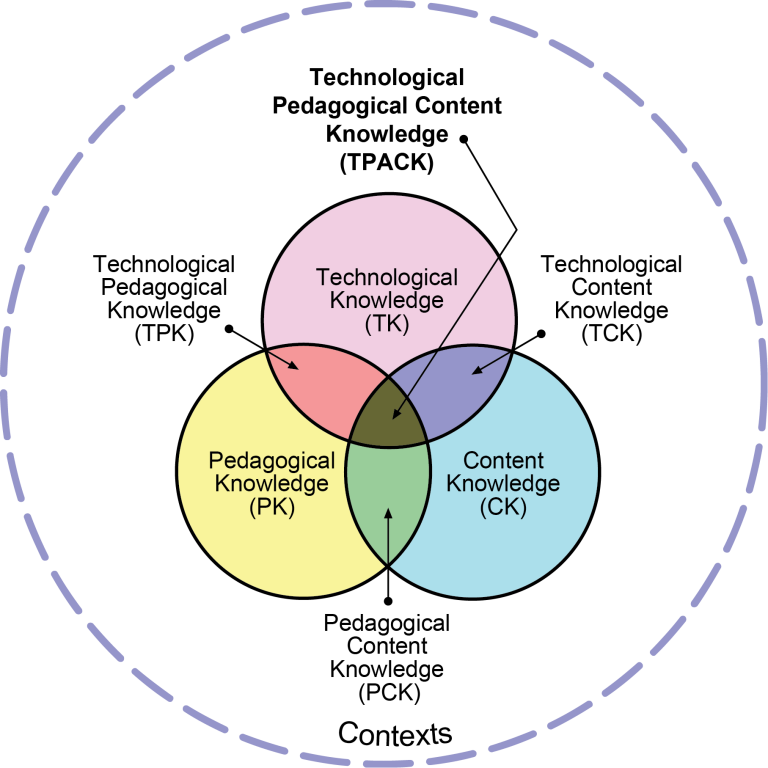
TPACK resonated with me when I first learned about it, because it matched my experience teaching. When I was teaching undergraduates as a sessional instructor I often was given courses I wasn’t familiar with on short notice. At first I was overwhelmed but as this happened more often I found I was able to rely on my knowledge about teaching (pedagogical knowledge) and my knowledge about the tools we could use while learning (technological knowledge) to sure up the places where I had weaknesses. It’s much easier to have a class understand when you say “I don’t know” if your teaching is mechanically sound in your practice and have a mechanism where you will get the information back to them.
That’s not to say that it’s easy to teach when your content knowledge is short, but it’s possible and I think for a lot of academics theres a certain amount of comfort in knowing that they can teach almost anything in their discipline if they really have to.
I also gained content knowledge as I taught. For example, when a student asked questions about how a constructor works in Java, I ended up going back though the high level notes, I had and the resources in the text book, and then eventually down into the documentation and code of the Java and the JVM to actually see what happens. That expanded my content knowledge and then I felt more confident in teaching that material.
Once I had that confidence, it was easier to modify how I taught it and the tools I used. The preferred environment for teaching programming at my institution at that time was BlueJ, which is good for visually thinking about Java classes and their constituents, but obscures things about how code runs and doesn’t have a very authentic workflow. I ended up switching to Eclipse (which required its own bundle of knowledges) because it allowed me to teach more concretely how programming languages work. Some times we also used repl.it which allowed us to implement coding drills (more on those in a follow up piece, but effectively changing pedagogy) and reduced the setup that students needed to learn.
When teaching operating systems and hardware, I knew from previous times teaching the course that students struggled with understanding how the processor accessed and executed instructions. I drew on my pedagogical knowledge and content knowledge to do an in class simulation of the processor and had students take on the roles of various processor components to execute a program. This helped students because we could *see* all of the elements of the processor working and when they went to the simulator in lab later on, they had that vibrant moment to call back to.
When I first learned about TPACK, I contextualized it in light of these teaching experiences and for me it validated that I didn’t have to be an expert in everything. If there are different types of knowledge I can be learning for each type and so I both have space for growth and have a sufficient level of expertise when I’m teaching, even if I’m not perfect.
References
Mishra, P., & Koehler, M. J. (2006). Technological Pedagogical Content Knowledge: A Framework for Teacher Knowledge. Teachers College Record, 108(6), 1017–1054. https://doi.org/10.1111/j.1467-9620.2006.00684.x
Shulman, L. S. (1986). Those who understand: Knowledge growth in teaching. Educational Researcher, 15(2), 4–14 https://www.jstor.org/stable/1175860