By: Ayishah Hasni
From the ancient world to the modern day, horses have played a role in almost every society, not only because of their versatility, but because of the remarkable bonds which they are able to form with their human riders. It is no wonder, then, why they also have multiple mythological counterparts that span across many cultures and religious traditions. In Islam, they appear in various literatures and with an array of supernatural characteristics, from the sea-stallions in The Voyages of Sindbad the Sailor to the centaur in Zakariya al-Qazwini’s The Wonders of Creatures and the Marvels of Creation. Winged horses, in particular, can be found in both the One Thousand and One Nights stories of The Enchanted Horse and The Tale of the Third Dervish, though arguably the most noteworthy are Al-Buraq and Haizum, the mounts of the Prophet Muhammed and archangel Jibreel, respectively.
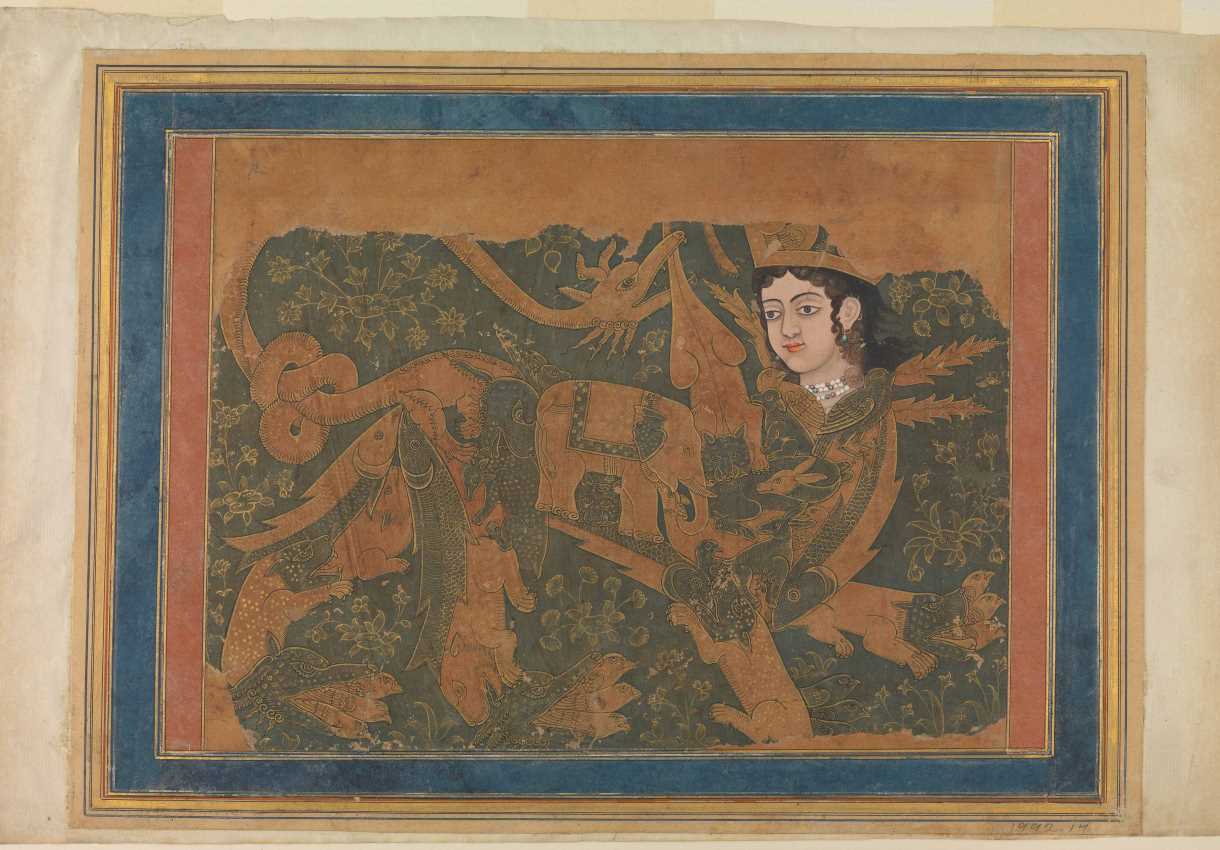
The parallelism between these two figures does not seem to be entirely coincidental, and also suggests a certain favourableness in Islam towards the equine form, especially as a mark of divinity. Al-Buraq first revealed itself to the Prophet Muhammed during the Night Journey, when it carried him from Makkah to the Al-Aqsa Mosque in Jerusalem and finally up to the Heavens to meet Allah and the previous Prophets all in a single night. While it is widely agreed upon that Al-Buraq has the body of a horse and a pair of feathered wings, it is also often described as having a human head, allowing it to become an “amalgamation of human, bird, and animal parts” (McLeod 102). Furthermore, it is said to be “a liminal creature… neither fully human nor fully animal… both masculine and feminine… [and] able to move between the earthly and spiritual worlds” (Bernier and Smith 401). Similarly, Haizum is described as a “white, flaming, spiritual horse with a pair of wings” without a specified gender (Sakalauskaite 8). While it lacks any characteristics that would categorize it as a human-animal hybrid, its perpetual “flaming” state suggests a supernatural ability that exceeds flight and speed. It is also important to note that while Al-Buraq’s description has been formulated based on biographical accounts of the Prophet Muhammed, Haizum is explicitly mentioned in the Quran, when Jibreel rides it into the battle of Badr (Wherry 16). Regardless, both creatures are believed to be entirely real in Islam, unlike some of the other mythological figures belonging to pre-Abrahamic societies that were later mingled in with Islamic art and literature.
Figure 2. Muhammad Ascends to Heaven in a Vision on Buraq, Folio from a Yusuf and Zulaikha of Jami, Author Maulana Nur al-Din ‘Abd al-Rahman Jami, ca. second half 16th century, Metropolitan Museum of Art (file omitted due to exceeding maximum upload size)
As Tayebe Jafary and Morteza Hashemi argue in their article titled “Analyzing the Prophet Mohammad’s Symbolic Horse in his Spiritual Ascension,” there is a certain symbolism attached to the horse and the rider as a pair. For example, they write that “in all myths and fables, the hero of the epic is always accompanied with a wonderful horse” (Jafary and Hashemi 74). While this may be true, there is certainly an opportunity for further research in regards to whether the Night Journey played a role in establishing that particular archetype. Jafary and Hashemi also argue that while the obedience of the horse reflects ethical conduct, the rider’s control of the horse simultaneously represents a triumph over evil (Jafary and Hashemi 77). To expand on this interpretation, the horse and rider therefore might also symbolize a Muslim’s relationship to Islam; while the tamed horse signifies the act of submitting to the faith, the rider itself is the Quran, acting as a guide that steers one closer to the Heavens.
On the contrary, however, an argument can be made that perhaps there is no symbolism at all, but horses are simply practical choices as mounts because of their companionable nature. For example, the Prophet Muhammed was known to love horses, and even said that there are blessings to be found in their foreheads (The Hadith, n.d.). Another miraculous encounter that involves him and horses is the origin story of the Al Khamsa (or “The Five”). As it goes, he was leading a herd of horses across the desert only to come across an oasis which they immediately ran towards to quench their thirst. As a test of their loyalty, he called them back, and only five returned, each of whom became the renowned founders of the Arabian breed (Hettema 2-3). Furthermore, since Jibreel is believed to be the one who brought Al-Buraq down from the Heavens himself, it makes sense that Al-Buraq would, to a certain degree, mirror the appearance of his own steed, Haizum. This is especially the case given that Haizum was also given to Jibreel as a reward from Allah (Sakalauskaite 8). Lastly, before they go down to Earth, Al-Buraq conveys to Jibreel that it “loves and misses [the Prophet]” despite having never met him before (Istiqomah and Sholeh 59). Therefore, a pattern becomes discernible in Islam that equines are specifically ridden by those who are considered worthy and well-deserving of loyalty.
The animalistic and supernatural characteristics of both Al-Buraq and Haizum can also be analyzed in greater detail. As Jafary and Hashemi argue, feathered wings, or conversely, birdlike attributes are representative of “holiness” and “ascension” towards the heavenly world, and therefore separation or freedom from the earthly (77-78). Furthermore, they state that because the upper half of Al-Buraq’s body is human, it suggests a “positive meaning” because the human parts are “closer to the heavens” (Jafary and Hashemi 77). Thus, Al-Buraq can be categorized as a pure, benevolent being, whereas hybridity is commonly seen as a mark of demonhood. By contrast, it remains puzzling as to why Haizum is considered to be a benevolent being despite possessing fire powers, since fire is typically associated with Shaytaan (Satan) and Jahannam (the Hellfire). While there does not seem to be any academic writing on the matter, especially because so little is known of Haizum aside from a single Quranic verse, it is certainly an area for greater speculation and analysis.
Due to the timeless appeal of the idea of humans taming wild horses to become their companions, it is obvious why they have always been awe-inspiring creatures that have become staples in both religious and secular stories. When caught up in such tales, it also does not seem unreasonable to believe that Pegasus, unicorns, hippocampi, or other extraordinary variations of horses once existed, and perhaps still do in the corners of the world that have not yet been explored.
Works Cited
Bernier, Ronald R. and Rachel Hostetter Smith, editors. Religion and Contemporary Art: A Curious Accord. Routledge, 2023.
Hettema, Hylke. “Al Khamsa: The Prophet’s Mares—Or Were They Stallions?” Cheiron: The International Journal of Equine and Equestrian History, vol. 1, no. 1, 2021, pp. 170-179, http://dx.doi.org/10.22618/TP.Cheiron.20211.1.233008. Accessed 22 June 2024.
Istiqomah, Himatul and Sholeh, Muhammad Ihsan. “The Concept of Buraq in the Events of Isra’ Mi’raj: Literature and Physics Perspective.” Academic Journal of Islamic Studies, vol. 5, no. 1, 2020, pp. 53-68, http://dx.doi.org/10.29240/ajis.v5i1.1373. Accessed 21 June 2024.
Jafary, Tayebe and Hashemi, Morteza. “Analyzing the Prophet Mohammad’s Symbolic Horse in His Spiritual Ascension.” Asian Culture and History, vol. 5, no. 1, 2013, pp. 74-78, https://doi.org/10.5539/ach.v5n1p74. Accessed 20 June 2024.
McLeod, Erin. “By a Wing and a Tale: Authenticating the Archive in Mohamad-Said Baalbaki’s Al Buraq I The Prophet’s Human-Headed Mount.” RACAR: Canadian Art Review, vol. 38, no. 1, 2013, pp. 97-105, https://doi.org/10.7202/1066667ar. Accessed 20 June 2024.
Sakalauskaite, Aida. “Zoometaphors in English, German, and Lithuanian: A Corpus Study.” 2010. University of California, Berkeley, PhD dissertation. EScholarship, https://escholarship.org/uc/item/63k6d8c7.
The Hadith, (pp. Sahih al-Bukhari, Book 56, Hadith Number 67).
Wherry, E.M. A Comprehensive Commentary on the Quran: Comprising Sale’s Translation and Preliminary Discourse: Volume II. Routledge, 2001. Taylor & Francis Group. https://doi.org/10.4324/9781315012346. PDF file